
Humanoids 2025
ANUBIS: A Compact, Low-Cost, Compliant Humanoid Mobile Manipulation Robot
ANUBIS는 로봇 바디 자체에 초점을 둡니다. 즉, compliant 팔, 전방향 이동성, 더 낮은 BOM 비용을 통해 가정용 모바일 매니퓰레이션 접근성을 높이려는 컴팩트 휴머노이드입니다.
Taewoong Kang, Joonyoung Kim, Shady Nasrat, Dongwoon Song, Gijae Ahn, Minseong Jo, Seonil Lee, Seung-Joon Yi
목차
- Introduction
- Overview of ANUBIS
- Safety by Design
- Dual-Arm Dexterity
- Real-time Teleoperation
- Contributions
- Hardware Architecture
- Compliant Dual-Arm Manipulator
- Lightweight Gripper
- Mobile Base
- Sensor Head
- Computing System
- Software Architecture
- Arm Motion Controller
- Natural Language and Automation
- Experimental Results
- Autonomous Bimanual Manipulation
- Real-Time Teleoperation
- Conclusion
Introduction
Population ageing, shrinking workforces, and the rising cost of care are converging to create an urgent demand for affordable in-home service robots [1]. To be useful in real apartments or small shops, a robot must (i) navigate cluttered, narrow passageways, (ii) manipulate everyday objects with two hands, (iii) interact safely with surroundings, and (iv) be affordable enough for mass deployment. Current commercial mobile manipulators typically compromise on at least one of these requirements: large footprints hinder doorway traversal, single-arm designs limit task throughput, high-stiffness actuation raises safety risks, and proprietary hardware increases the system cost and limits customization options [2], [3], [4], [5].

Overview of ANUBIS
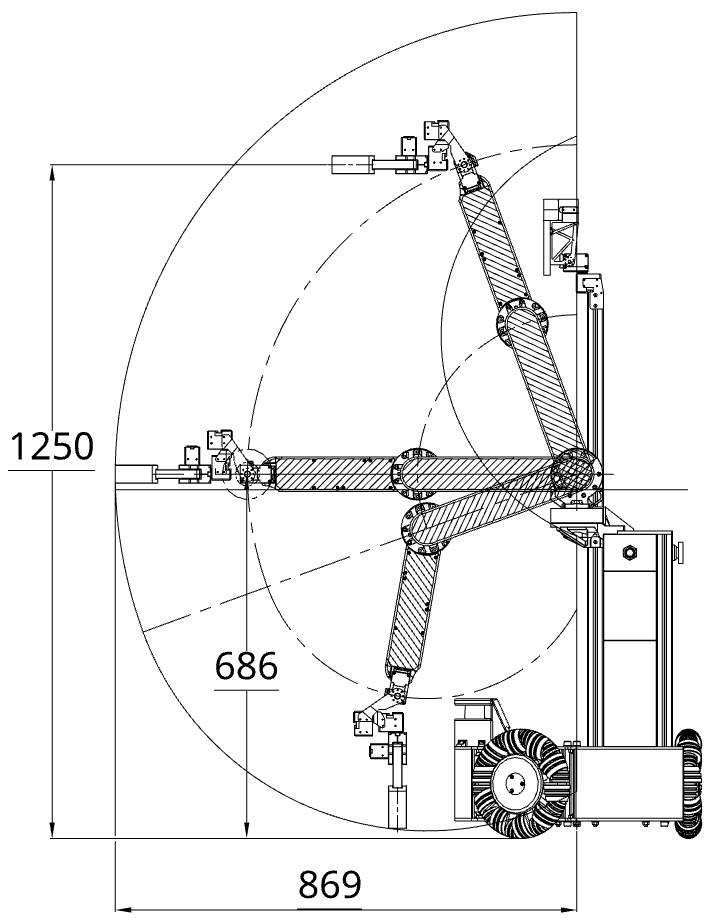
We present ANUBIS: a compact, low-cost, and compliant humanoid mobile manipulation platform built for routine domestic and light-logistics duties (Fig. ). ANUBIS fits two lightweight, compliant 6-DoF arms entirely inside a 500 mm circular footprint, mounted on an omnidirectional base. The extensive use of off-the-shelf components and 3D-printed structural parts reduces weight and keeps the bill of materials as low as USD 11,200, yet still supports 1.5 kg payload per arm and a vertical reach from floor to 1.25 m.
Safety by Design
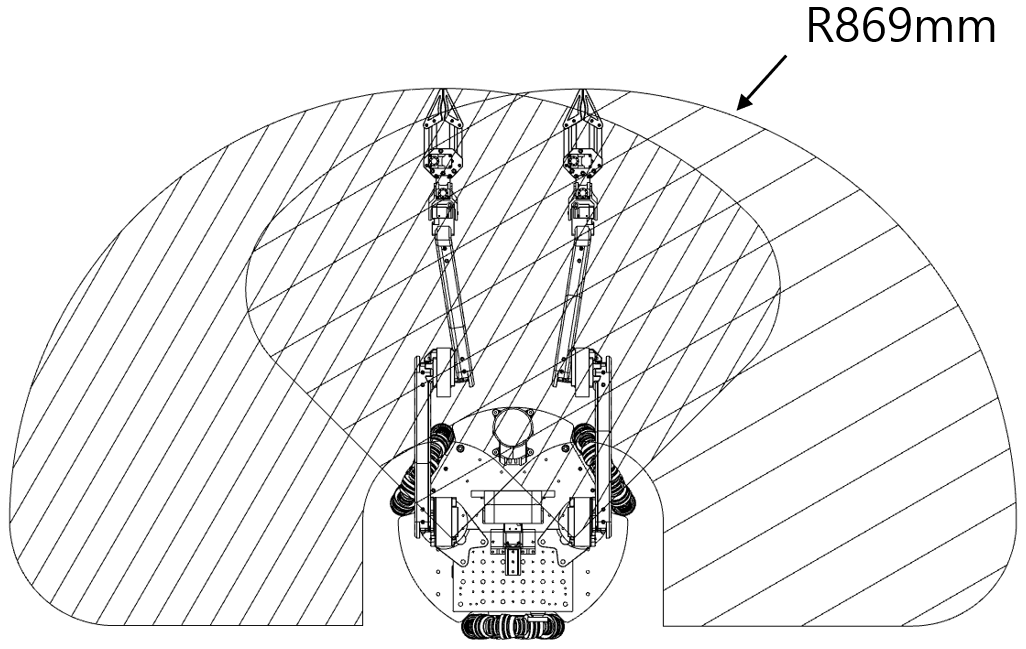
Compactness is not just a convenience but a safety feature: with no links protruding beyond the chassis outline, the robot can rotate in place without sweeping hazards. Compliance is achieved through quasi-direct-drive actuators and a multi-layer impedance controller that detects unexpected contacts and modulates arm stiffness in real-time. A software safety supervisor further limits joint torques and base velocities based on the local scene map, ensuring safe navigation in tight quarters and safe manipulation around people.
Dual-Arm Dexterity
Two arms allow bimanual behaviors unavailable to single-arm platforms: cooperative lifting, hand-to-hand transfers, simultaneous pick-and-place, or one-hand-steady/one-hand-operate actions (e.g. wiping while holding). Task execution latency is cut nearly in half because both arms can fetch and stow different objects concurrently, a key advantage for household chores and shelf restocking.
Real-time Teleoperation
For tasks that still exceed current autonomy, or to obtain training data for data-driven motion controllers, ANUBIS provides a real-time master–slave teleoperation interface. Detachable master controller sends a low-latency control stream to the robot over Wi-Fi, and the robot sends back current video stream, joint angles, and compliance states while replicating the motions of the master controller.
(a) (b) (c)
Contributions
The primary contributions of this work are:
Hardware design: a dual-arm humanoid mobile manipulator that fits inside a 0.5 m footprint while retaining 1.25 m vertical reach and 1.5 kg payload per arm.
Safety architecture: a combined mechanical–electrical–software approach that enforces compliance, impedance, and speed limits for safe human–robot coexistence.
Low-cost fabrication: a bill-of-materials under USD 11,200, using off-the-shelf actuators and 3D-printed carbon-fiber parts, lowering the barrier to entry for service-robot research.
Dual-arm autonomy & real-time teleoperation: integrated planning, perception, and a real-time master–slave teleoperation mode validated in cluttered apartments.
Through these features, ANUBIS establishes a practical, affordable testbed for studying whole-body coordination, tactile human–robot interaction, and dual-arm manipulation in the very spaces where such capabilities are most needed.
Hardware Architecture
Compliant Dual-Arm Manipulator
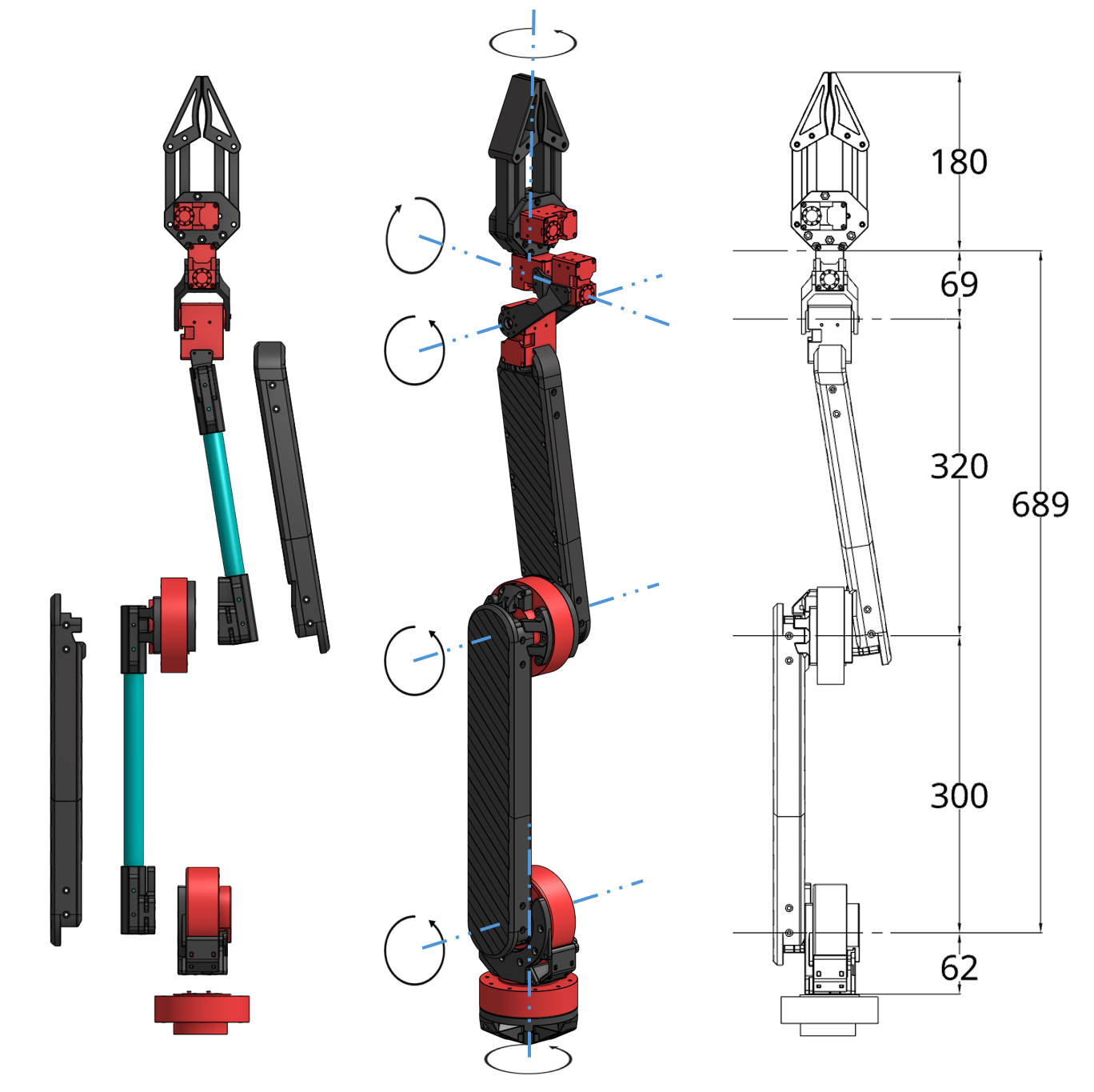
Instead of relying on commercial arms, ANUBIS uses a pair of custom-built, lightweight manipulators (Fig. ). Each arm is built from carbon fiber tubes bonded to 3D-printed lugs and reinforced with carbon-fiber-reinforced PLA parts. The covers are printed using standard PLA for ease of replacement and lightweight enclosure.
The arms are actuated using a combination of actuators optimized for compliance and precision. The shoulder and elbow joints use QDD actuators with a 9:1 reduction ratio to deliver high backdrivability and safe interaction. The wrist joints are powered by compact Dynamixel servomotors with higher gear ratios for accurate end-effector control. All joints are directly driven—no belts or secondary linkages—minimizing backlash and simplifying the design.
Excluding the gripper, each manipulator weighs 2.9 kg and provides reach from floor level up to 1.25 m. The bimanual workspace at shoulder height covers approximately 0.6 m2, as illustrated in Fig. .
(a) Side‐view
(b) Top‐view
Lightweight Gripper
The end-effector of each arm is a custom-designed, lightweight two-finger gripper inspired by the Robotiq 2F-140. It uses a 3D-printed parallelogram linkage actuated by a Dynamixel servomotor in a daisy-chained configuration, geared at 2:1 for higher torque. The gripper includes flat-edged high-friction fingertips for gripping thin items, and curved inner surfaces to stabilize larger objects. Weighing only 330 g, the gripper achieves a clamping force of 89 N—approximately 71% of the force of the Robotiq model, at one-third the weight. The combined arm–gripper system supports a theoretical peak payload of 4.5 kg based on actuator specifications, and we have found that the system can reliably pick up a payload of 1 kg repeatedly without any serious heat buildup at the actuators as demonstrated in Fig. a.
| (\(N\cdot m\)) | |||||
| (rad/s) | |||||
| (mm) | |||||
| (g) | |||||
| Joint 1 | 30 | 22.51 | link 1 | 62 | 796 |
| Joint 2 | 40 | 16.76 | link 2 | 300 | 891 |
| Joint 3 | 30 | 22.51 | link 3 | 320 | 487 |
| Joint 4 | 10.6 | 3.14 | link 4 | 40 | 105 |
| Joint 5 | 4.1 | 4.82 | link 5 | 29 | 86 |
| Joint 6 | 4.1 | 4.82 |


(a)(b)
Mobile Base
To navigate crowded, real-world environments like homes and small shops, a service robot must combine compactness, smooth motion, and precise control. ANUBIS addresses these challenges using a 500 mm-diameter circular chassis equipped with three 206 mm omni-wheels fitted with compliant TPU rollers(Fig. ). This three-wheel omnidirectional configuration enables full planar motion—translation and rotation—while maintaining a tight turning radius and the ability to fit through standard doorways, and has step traversability comparable to differential drive robots thanks to the large TPU rollers. Three wheels are directly driven by high-torque QDD motors, resulting in high acceleration and controllability crucial for nimble maneuvering in a cluttered indoor environment. Although the wheels are currently controlled by a high-gain velocity controller, we plan to use a torque-based control that we use for the arms to make the base compliant to external forces.

Sensor Head
At the top of the torso, ANUBIS features a compact sensor head for visual perception and human interaction, which is shown in Fig. b. It integrates an Orbbec Femto Bolt depth camera mounted on a pan-tilt neck for flexible scene observation. A small front-facing LCD screen visualizes internal state, perception outputs, and dialogue subtitles—facilitating transparent, intuitive human–robot interaction. Additionally, a directional microphone enables focused audio capture for reliable speech recognition in noisy environments.
Computing System
ANUBIS’s computing architecture is composed of three networked units:
An Intel NUC serves as the central control unit, handling high-frequency tasks such as localization, navigation, and motion planning for both the base and arms.
An NVIDIA Jetson Orin 64GB handles GPU-intensive workloads, including visual perception and audio processing.
A Steam Deck functions as a real-time interface for human teleoperation. It displays system status (e.g., mapping, object detection) and enables direct control using built-in joysticks, buttons, triggers, and touchscreen input.

All actuators are controlled via CAN bus and RS-485 interfaces routed through the NUC. Audio I/O for the microphone and speaker is handled by the Jetson. All units are connected over a gigabit Ethernet switch to ensure low-latency communication. Fig. shows the internal layout and key components of the system.
Software Architecture
We use a modular robot software framework that supports a variety of different robotic hardware, including humanoid robots[6], [7], quadrupeds[8], stationary robotic manipulators[9], and wheeled service robots[10], [11], [12]. Thanks to the modularity of the framework, most of the code can be straightforwardly shared between multiple wheeled service robot platforms, except for a new arm motion controller required for the compliant dual arm hardware of the ANUBIS robot.
Arm Motion Controller

We have developed a new multi-layered arm controller to control the compliant manipulators of the ANUBIS robot. At the lowest level, joint-level PD controllers control shoulder and elbow joints via torque commands at a high-frequency of 1 kHz. To ensure compliance of the arm joint while keeping positional accuracy, we use feedforward gravity compensation torque inputs with low proportional gain values. As a result, the arms can achieve good positional accuracy for autonomous manipulation of household objects. In addition to the joint-level PD control, we also provide a Cartesian impedance controller layer, which can use different values of impedance for each axis. This control method can provide an effective means of tactile HRI without the help of a force-torque sensor. Fig. shows a handover scenario using the Cartesian impedance controller, where the arm is set to be compliant only on the X axis. Once the human grabs and pulls the object, the robot detects the arm displacement and releases the item to complete the handover behavior.
At the high level, our arm motion planning module uses a number of parameterized motion primitives, designed for manipulating objects at different heights and approach angles. We have successfully utilized previously designed motion primitives for autonomous manipulation of objects, which are shown in a later section of the paper.
Natural Language and Automation
Our system employs RDMM[13], a fine-tuned on-device language model, to translate natural language into robotic actions with contextual understanding and memory access. Trained on over 27,000 task-specific samples, RDMM empowers the robot to:
Execute multi-step commands, such as “Bring me juice and sit with me,” combining navigation, manipulation, and interaction.
Respond with self-awareness, answering “Who are you?” or “What can you do?” with personalized, informative replies.
Recall memory-based events, adapting behavior based on previous interactions or environmental changes.
Interpret abstract instructions, like “Help me with something,” and convert them into executable plans.
Unlike cloud-dependent models, RDMM runs fully on-device with low-latency inference and robust privacy. It interfaces seamlessly with local perception models and control stack, including object/person detection, speech recognition, text-to-speech, vision, and a controller module for real-time execution—enabling full-scope robotic autonomy and interaction — enabling the robot to act, see, speak, and respond in real-time.
Experimental Results
We evaluated ANUBIS in real-world scenarios typical of domestic service applications, focusing on two core use cases: autonomous bimanual manipulation and real-time teleoperation. These experiments validate the system’s capabilities as both a functional service robot and a robust research platform. The following results build upon the hardware and software design principles introduced in Section and .
Autonomous Bimanual Manipulation
To assess autonomous manipulation performance, we conducted a trial representative of daily household interaction. Following a verbal command to retrieve a specific object, ANUBIS autonomously navigated to a cluttered workspace, visually identified the target item, and executed a bimanual pick-and-place operation. The robot then returned the object to the user without external assistance. This experiment verified the system’s ability to integrate perception, navigation, and dual-arm coordination in a fully autonomous pipeline, as seen in Fig. .
Real-Time Teleoperation
We also tested the system’s teleoperation interface using a paired low-cost version of the custom arm as a master device. The operator controlled the robot remotely in real-time, using visual feedback from the robot’s head-mounted camera. This master–slave setup confirmed ANUBIS’s responsiveness, transparency, and suitability as a hands-on research platform for studying human-in-the-loop manipulation and remote operation, as seen in Fig. .
Conclusion
This paper presented ANUBIS, a compact, compliant, and low-cost humanoid mobile manipulator designed for safe operation in domestic environments. By integrating two lightweight 6-DoF arms within a cylindrical 500 mm omnidirectional base, ANUBIS maintains a minimal footprint while enabling versatile bimanual manipulation. The use of quasi-direct-drive actuators and multi-layer impedance control provides inherently safe and compliant interactions, even in cluttered, unstructured spaces. Through the use of 3D-printed carbon-fiber structures and off-the-shelf components, the platform remains highly affordable, with a total material cost of approximately USD 11,200. We demonstrated its effectiveness through real-world tasks including autonomous dual-arm manipulation, vision-guided table cleaning, and low-latency teleoperation.
Together, these results validate ANUBIS as a capable and accessible testbed for home-service robotics. Its balance of performance, safety, and affordability highlights its potential to accelerate research and deployment of compact mobile manipulators in everyday environments.